

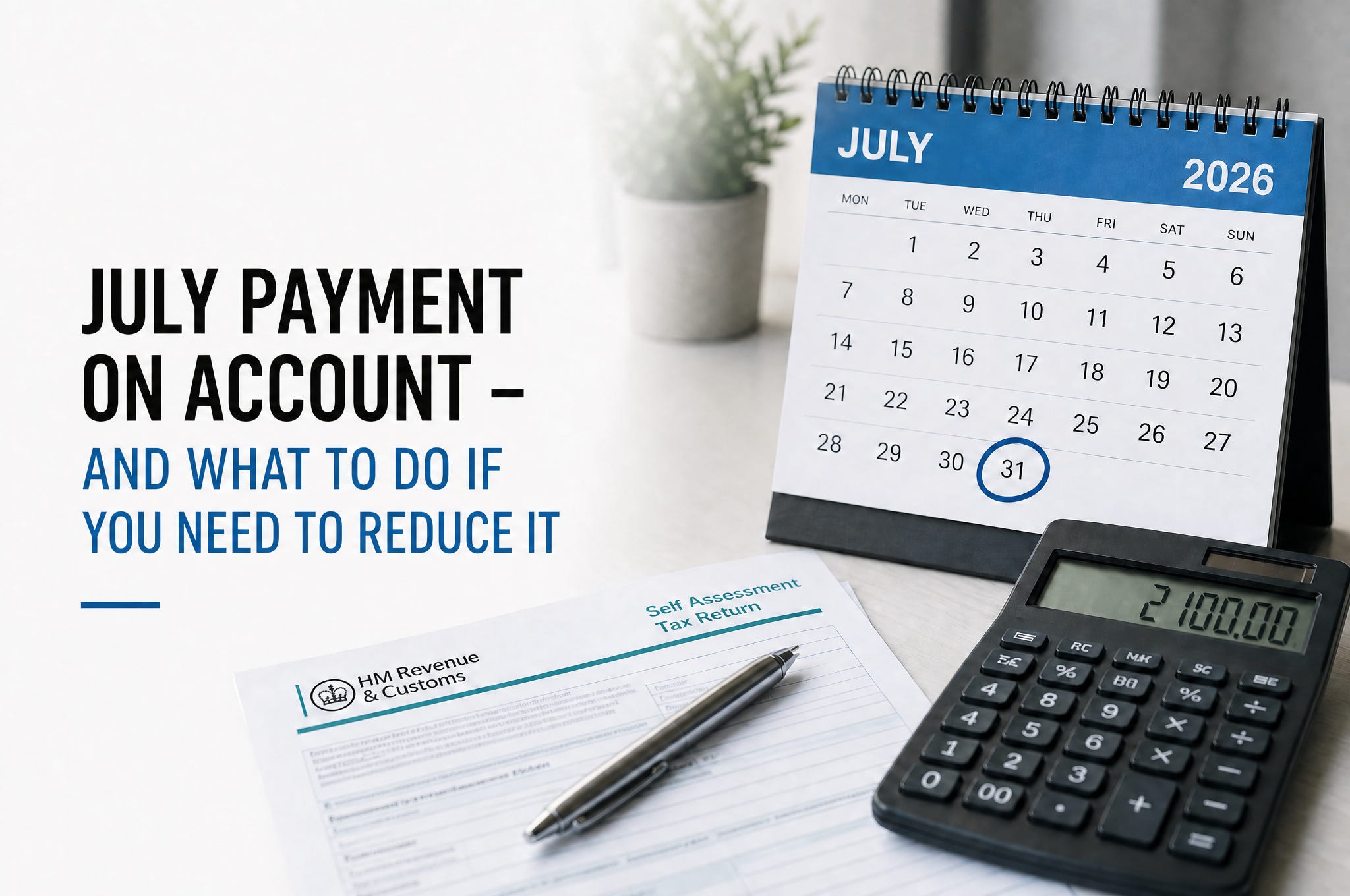
Taxpayers within Self-Assessment must make payments on account towards their next tax and Class 4 National Insurance bill if the tax that they owed for the previous tax year was £1,000 or more, unless they paid more than 80% of the tax that they owed for that year outside Self-Assessment, for example, under PAYE. Each payment on account is 50% of the tax and Class 4 National Insurance liability for the previous tax year. The payments must be made by 31 January in the tax year and 31 July after the tax year. If more tax and Class 4 National Insurance is due for the year, the balance must be paid by 31 January after the end of the tax year.
Example
Tom is a self-employed gardener. In 2024/25 he had profits from self-employment of £45,000. He paid tax of £6,486 and Class 4 National Insurance of £1,945.80 – a total bill of £8,431.80.
As his total tax and Class 4 National Insurance bill is more than £1,000, he must make payments on account towards his 2025/26 bill. Each payment on account is £4,215.90 (50% of £8,431.80).
31 July 2026 deadline
The second payment on account for 2025/26 is due by 31 July 2026.
If payment is not made on time or the full amount is not paid by this date, interest will be charged from the due date of 31 July 2026 to the date that the payment is made in full.
Review the payments
As the July payment on account is made after the end of the tax year to which it relates, the profit for that tax year may be known. Where this is the case, the payment on account should be compared to the actual payments which will be due for the year. If taxable income has fallen, for example, because profits are less in 2025/26 than in 2024/25, the payments on account can be reduced.
Example
The facts are as in the example above. In June 2026, Tom does his accounts for 2025/26. During that year, he took some time off to care for his elderly mother. As a result, his profits have fallen and for 2025/26 are £36,000. His tax bill for 2025/26 is £4,686 and his Class 4 National Insurance bill is £1,405.80 – a total of £6,091.80.
If Tom makes two payments on account of £4,215.90, he will overpay by £2,240 Consequently, he reduces his payments on account.
Reducing payments on account
Where a taxpayer knows that their bill will be lower this year than last year, they can ask HMRC to reduce their payments on account. The taxpayer can do this online by signing into their personal tax account, selecting the option to view their Self-Assessment return and selecting the ‘reduce payments on account’ option. An application to reduce payments on account can also be made by post on form SA303.
Example
The facts are as in the above example. Tom opts to reduce each payment on account to £3,045.90 (50% of his 2025/26 liability). He paid £4,215.90 on 31 January 2026. He must therefore pay £1,875.90 by 31 July 2026. The payments on account will match his 2025/26 liability so there will be no balancing payment to make by 31 January 2027 (although the first payment on account for 2026/27 of £3,045.90 will be due by that date).
It is important to note that if the payments on account are reduced by too much, interest will be charged on the shortfall.
Found this article useful?
If you know someone who may benefit from this information, please consider sharing it with them. A simple share could help a friend, family member, landlord, or business owner avoid costly mistakes and make better-informed decisions.